Odiham history
Odiham Common and the old deer park
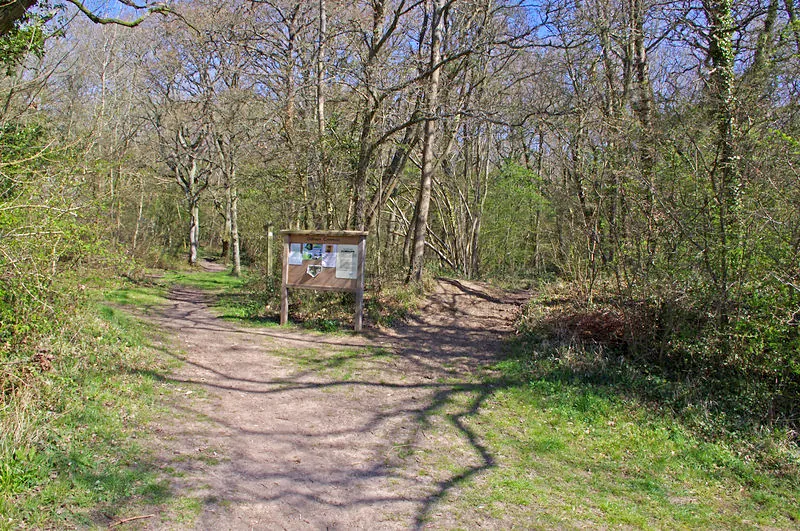
Odiham has two very different old landscapes on its doorstep. To the north is the outline of the medieval royal deer park, now farmland. To the north-east is Odiham Common, a big rambling wood pasture of oaks, hazel and glades that still feels a bit wild, especially after rain.
The deer park
The royal park is older than the castle. A park keeper, Hugh the Parker, is on record in 1130 to 1131, and Hart District Council's appraisal thinks the park may have been made before the Norman Conquest. Medieval kings hunted here, granted deer from it as gifts and kept a royal stud of horses in it in the early 1300s. Hampshire Gardens Trust describes Odiham as a rare example of a former royal deer park, unusually well documented, and says traces of the park pale (its boundary bank) can still be seen on the east side at Colt Hill and Poland Lane, with remains of fishponds on the Whitewater.
The northern Great Park was turned into fields soon after Charles I sold the manor to Sir Edward Zouche in 1630, though the Victoria County History says the park was still described as well stocked with deer that year. The southern Little Park was kept as the park of Odiham Place and enclosed some time between 1708 and 1736. The Canal and later the M3 both cut across the old park. Look at an aerial photo and you can still pick out its oval outline, with kinks at the old gates.
Odiham Common
Odiham Common is now part of the Odiham Common with Bagwell Green and Shaw Site of Special Scientific Interest. Natural England's citation describes it as wood pasture, meadow and common land, historically managed as oak standards over hazel coppice, with cattle grazing and coppicing still going on in places. The site has 39 plants that indicate ancient woodland, including woodruff, early-purple orchid, wood sanicle, Solomon's-seal and narrow buckler-fern.
The Victoria County History of 1911 lists the parish's commons as Odiham Common to the north-east, Bartley Heath to the north-west (which had a golf course then) and Horsedown Common to the south-east. Hart's appraisal mentions that tenants had a common right to dig chalk, and that chalk pit appears as far back as Domesday.
Walk it
Our Odiham Common and canal walk is a good loop, and there's mud in winter, so wear boots. More routes are in walks around Odiham. Back to the Odiham history hub.
Walk there (Google Maps)Odiham Common (Broad Oak Bridge entrance)