Odiham history
Odiham Castle (King John's Castle)
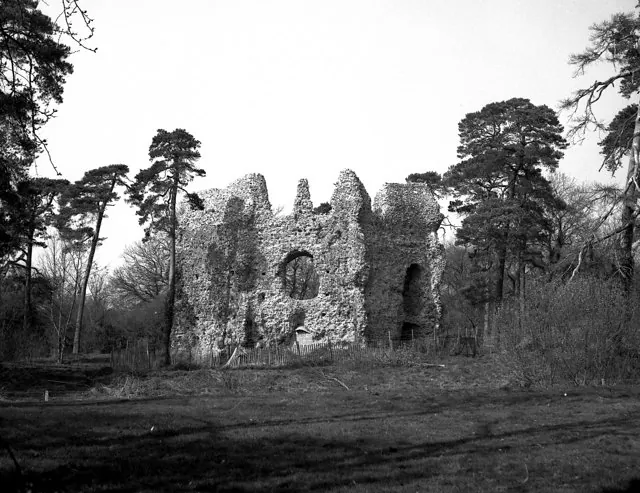
The castle is a ten-minute stroll along the canal towpath from North Warnborough, and the first time you see it you might be a bit puzzled. There's no gatehouse and no curtain wall, just one tall, broken, eight-sided flint tower in a meadow, with the canal running past on one side and the River Whitewater on the other. But that ruin was once one of King John's favourite places in England.
Why here?
John picked a new site in 1207, on 20 acres of meadow he took from a man called Robert the Parker. (Robert was still being let off part of his rent in 1235, because the king had taken his meadow and burnt his mills.) The spot is roughly halfway between Windsor and Winchester, it sat beside the royal deer park, and a loop of the river gave it natural defences. One chronicler says John built it "pur lui deporter", for his enjoyment. Hunting, in other words.
The Pipe Rolls show work starting in 1207 with the digging of the "square moats" and a King's house, and carrying on until about 1214. The excavators estimate it cost more than £1,000. Odiham was one of only four new castles the Angevin kings built in England.
King John and Magna Carta
John came here a lot. The Victoria County History lists visits in 1204 (before the castle), 1207, 1208, 1209, 1210, 1212, 1213 and 1215. In June 1215 he was at Odiham on the 4th and the 9th, and according to the VCH he was "summoned thence by the barons to Windsor previous to granting Magna Carta". He passed through again on 26 June on his way back to Winchester. His last visit was 14 to 18 April 1216.
You'll often read that John rode out from Odiham on the morning of 10 June 1215 to meet the barons at Runnymede. The Odiham Society puts it as "it is believed", and that's the right way to say it. The records put him here on 9 June, so it's plausible, but we haven't found a document that proves the ride. And Magna Carta was sealed at Runnymede, not at Odiham, whatever some websites say.
The siege of 1216
A year after Magna Carta the barons had invited Prince Louis of France to take the throne, and in summer 1216 his army arrived at Odiham. King John wasn't there. The castle was held by Engelard de Cigogné's garrison, which the chroniclers say was just three knights and ten serjeants.
The VCH, following the chronicler Matthew Paris, tells it like this: the French battered the castle with siege engines for three days, then the defenders came out, fought an equal number of the enemy and got back inside unhurt. After about fifteen days they surrendered, on terms that let them keep their arms and horses. When only 13 men marched out, the French were, in Paris's words, filled with astonishment and admiration. The castle report dates the surrender to 9 July 1216.
Queens, a parliament and a rebellion
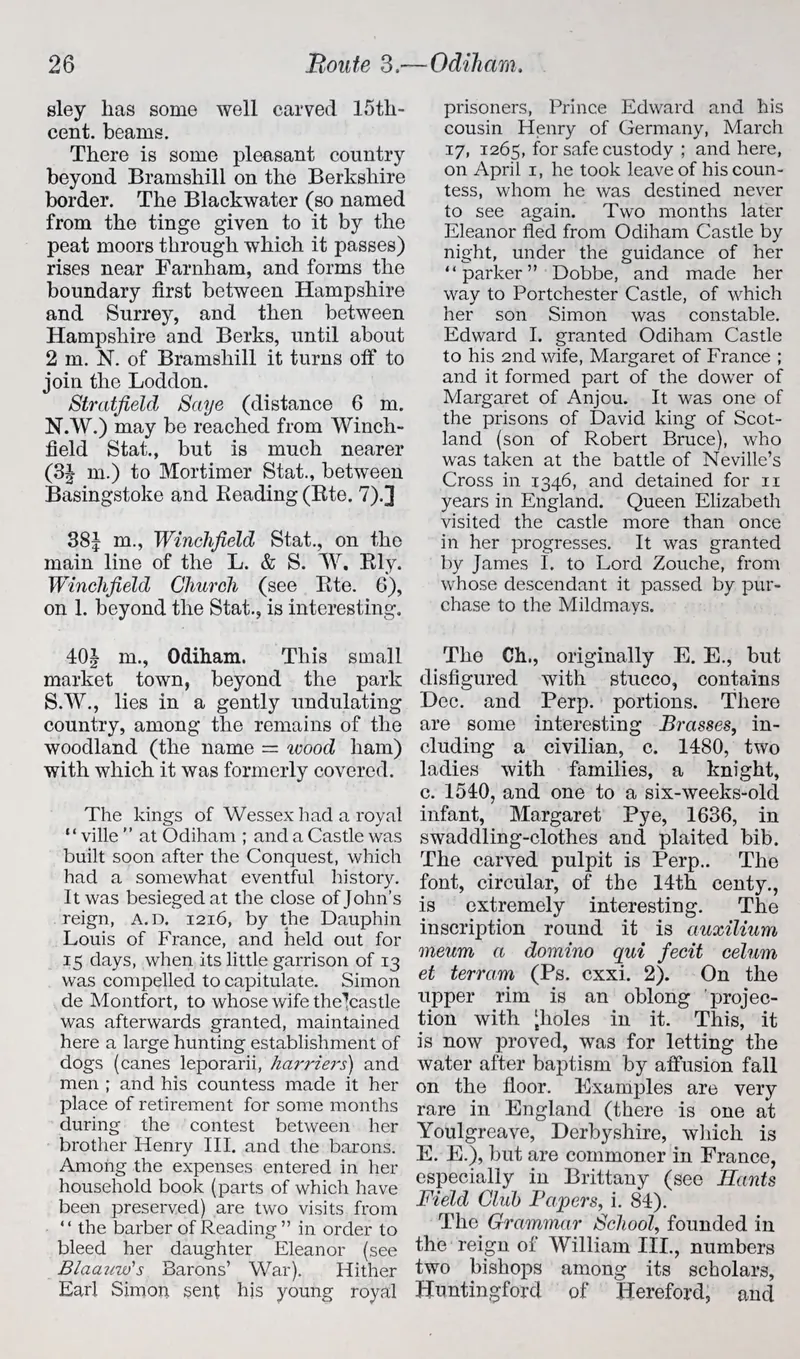
After John's death the castle passed through a long list of royal keepers. Henry III gave it to his sister Eleanor in 1236, and she married Simon de Montfort in 1238, so for twenty-odd years this was a de Montfort family home. Eleanor's household accounts for February to August 1265, the months before Simon was killed at Evesham, survived because she took them into exile in France. They're now in the British Library and list what was eaten at Odiham, including vast amounts of salted herring in Lent.
A parliament met at Odiham in 1303. In 1322 a former keeper, Robert le Ewer, tried to take the castle by force. The garrison fired eight dozen of its twenty dozen arrows driving him off, then got through two and a quarter casks of the castle's wine celebrating. The castle was also granted to a run of medieval queens, including Isabella, Philippa of Hainault and Anne of Bohemia.
David II of Scotland
David II, King of Scots, was captured at the Battle of Neville's Cross in 1346 and spent eleven years as a prisoner in England. Plenty of websites (and the old 1868 gazetteer) say he spent all eleven years at Odiham. He didn't. The castle report, based on Patricia MacGregor's study of the records, says he was held at Odiham from March 1355 to September 1357, at the end of his captivity, before being sent home for a large ransom. That's still two and a half years, which is a long time to look at the same meadow.
Decline and the canal
By the late 1300s the castle mattered more as a hunting lodge than as a fortress. In the 1430s a repair bill of nearly £32 spent only about £1 on the castle and the rest on the park. It had fallen into ruin by the early 1500s, and it played no part in the Civil War. When the Basingstoke Canal was dug in the 1790s it cut straight through the south-west corner of the outer moat.
What the archaeologists found
Hampshire County Council bought the inner ward and keep in 1977, and the county museums service dug there every year from 1981 to 1985. They found that buildings and a moat came before the octagonal keep, which seems to have been added a bit later and off-centre. A timber-lined well inside the keep gave a tree-ring felling date of 1235 to 1267, and a coin from around the 1240s was found in its construction pit. So the keep you see may be a little later than the "built by King John" label suggests, or at least was still being fitted out under Henry III. The report itself says the dating "remains difficult".
The keep is about 12 m (40 feet) across inside, built of flint that was once faced with dressed stone. It's a scheduled monument and Grade I listed. You'll sometimes read that it's the only octagonal keep in Britain. It isn't: Chilham in Kent has one of the same internal size, and Orford and Tickhill are other polygonal towers.
Visiting
The castle is free to visit and open at any reasonable time. It's easiest on foot along the canal towpath from Colt Hill or North Warnborough; our canal walk from Colt Hill to Odiham Castle and the Odiham, North Warnborough and castle loop both go there. Dogs are welcome on leads. Please don't climb on the walls.
Back to the Odiham history hub, see the Odiham guide for nearby pubs.
Walk there (Google Maps)Odiham Castle (King John's Castle)
Sources
- Victoria County History, Hampshire vol. 4 (1911), Odiham, "Castle" section
- Allen & Stoodley (2010), "Odiham Castle, Hampshire: Excavations 1981-85", Hampshire Studies 65, pp. 23 to 101
- Historic England, Odiham Castle scheduled monument (1008705)
- Historic England, Odiham Castle Grade I (1092165)
- The Odiham Society, Visit Odiham
- GENUKI transcription of the National Gazetteer (1868), for the "eleven years" claim